

For the last 26 years, I have been part of a big family of people who know why birds sing.
I’m a skydiver.
I’m not an adrenalin junkie; I just love the feeling of piloting my body in a flow of air and being a part of this amazing community.
Skydiving takes many forms from belly flying to wingsuit flying and canopy piloting. I prefer Freefly: piloting my body in three dimensions in freefall with friends. Skydiving solo is one experience, freeflying with friends is something else.
Within Freefly is a very specific discipline: Freefly big-way records.
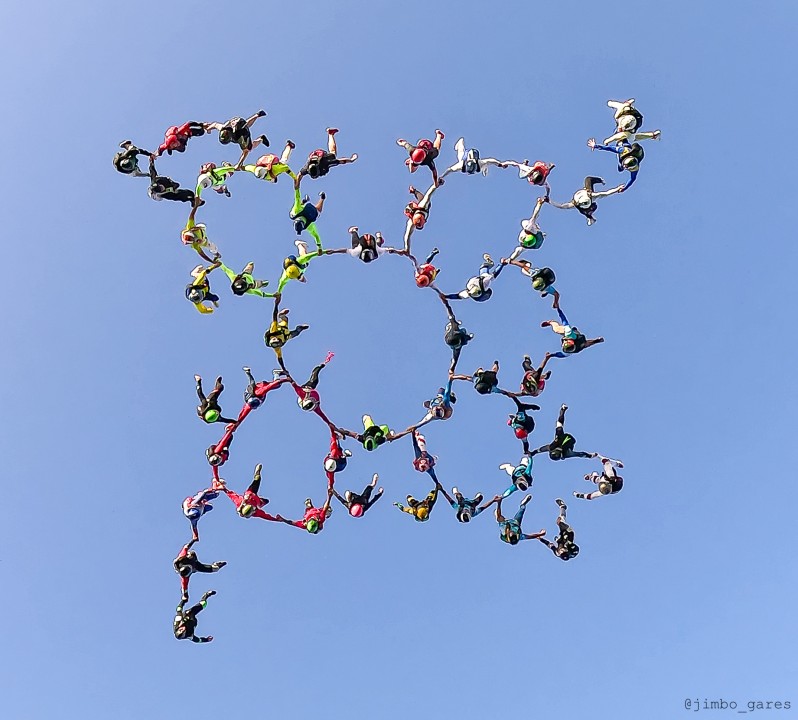
The objective of a Freefly big-way record is to build the biggest possible formation in freefall with all flyers flying head-down, gripping each other. As you can imagine, team dynamics is particularly important.
The current world record was set in 2015 with 164 flyers. The last French record was set in 2014, with 48 flyers. Until we broke it in 2023.
How it works
We exit from several planes, converging toward the base (6 or 8 people who form the center of the formation). We each have a dedicated slot in the formation where we have to grip. Each of us has a unique role in the team.
Before jumping, the organizers submit a formation plan to the judges who compare it to a video of the jump. Each flyer has to be there. If the organizers submit a 60-way formation, and only 59 flyers are gripped, it doesn’t count as a 59-way record.
Most skydivers participating in these record attempts are very experienced, with at least 1000 skydives completed. To participate in a record jump, flyers) attend training and selection camps. There are always more flyers than the number targeted for the record. The reserve group jumps as much as the main group. When a flyer in the main group doesn’t perform well or does something dangerous, they are relegated to the reserve group and someone from the reserve group takes their place.
The record attempts usually take place over a week and require a lot of preparation in terms of logistics, selection, and coaching.
Although the action takes place at 300km/h, the French Freefly big-way record has been more of a marathon than a sprint. It has been a test of resilience; it took us 9 years to beat the record we set in 2014. We tried in 2017 and failed. Several subsequent attempts were cancelled due to COVID-19 and such. We tried again in 2021, but we had a whole week of rain and not one single jump. Finally, all the stars aligned in 2023.
This useless but beautiful objective was fueled by a dream to experience the few seconds of eternity in a large Freefly formation. We learned a lot technically, and about ourselves, but the path was paved with lots disappointment, failure, frustration, stress, self-doubt, and physical challenges (my body certainly did not get any younger in those 9 years).
Why it’s stressful
This type of jump is very demanding and stressful for everyone involved, including the best flyers.
1. Your performance affects the overall success of the record, and at each jump, you run the risk of being kicked out of the main group if you don’t perform well.
2. If you’re in the reserve group, you have to deal with your frustration. If you let your frustration affect you, your flying will be affected, and you will lose your chance to join or rejoin the main group when someone is relegated.
3. You have to be disciplined and trust that the others will. The danger of those jumps is real; there are a lot of people in the sky at the same time. You need a great deal of attention and awareness, particularly at the break-off before opening your parachute, and under the canopy.
4. As these jumps are usually done at a higher altitude than usual (5700m instead of 4000m for a regular skydive), the climb in the plane is much longer, so you have to deal with minus temperatures and lack of oxygen (skydivers take oxygen from a bottle from 4000m)
5. It’s slow. We spend a lot of time rehearsing the jump (at least twice before each jump), so that each flyer can visualize the others around their slot and knows where to go in the formation once in freefall. After each jump, the organizers watch the videos of the jump and assess the performance of each flyer to debrief and modify the formation. We usually do a maximum of 5-6 jumps a day with a lot of waiting around; there’s plenty of time for pressure to build up between each jump.
6. The success of the record is weather-dependent, more so than on a regular skydiving day; you cannot compromise on safety with so many skydivers in the sky.
Key team success factors
1. Mental visualization
When you are flying head down at more than 300km/h with 59 friends around you and a crazy objective in sight, it’s hard to concentrate. Brainlock happens. You forget where you have to go in the formation and even the basics of a clean and efficient approach. We call this the amygdala highjack phenomenon. Because of the high stress, your thinking brain shuts down and your field of attention reduces, leading to tunnel vision and an excessive focus on where you have to grip. You forget the fundamentals: approaching level with the formation, flying in a calm and relaxed way before approaching, breathing before taking the grip…
The experience we accumulate in each jump is limited to about a minute of flying. But the brain doesn’t really distinguish between living something and visualizing it if we visualize with full attention. By repeating the jump mentally many times, we trick the brain into thinking that we have done this many times before. This is key to decreasing anxiety and freeing some mental space to adapt to unexpected situations.
We attended some Zoom sessions with a coach specialized in mental visualization. He showed us how to break down a record jump into several steps and describe for each step what we see, how our body looks from the outside, how it feels physically, and what our internal dialogue and emotional state are. We would then build a visualization plan over a month, focusing on a key step of the jump for a few days before putting all the steps together. We did that visualization exercise after a 5-minute breathing session 3 times a day for a month before the record attempt, knowing that the more precise and richer the visualization was, the more we would trick the brain into thinking this was something we had done many times.
On the day itself, we rehearsed each jump on the ground twice before jumping, with intense concentration. Then we visualized the jump again in the plane on our way up.
Beyond the stress management aspect, this turned the key steps of the jump into automated processes and helped us to adapt to the situation and deal with any unexpected event during the actual jump.
Adaptability is critical. Each jump is different. For example, we needed to coordinate the jump from 3 different planes. The alignment and synchronization of the planes were not always the same, so sometimes people jumping from one of the tail planes ended up at a different position from the base than what they had anticipated, either higher, lower, or farther than expected. Repeated mental visualization helped to free some mental space to adapt to this kind of situation.
In the 2023 jumps, I felt a huge difference in my own level of stress and preparedness although I could attend only one day of training. For the previous attempts, I had attended more training sessions, but didn’t do the mental visualization work; my level of stress was much higher and I felt much less prepared.
2. Stress management
We cannot eliminate the fear, but we can learn to live with it and transform it into a useful driver. Fear and stress are natural mechanisms which are intended to preserve your life and body integrity by triggering physiological mechanisms (fight or flight response) such as adrenalin release, which will increase blood flow to the muscles, increase blood sugar levels, raise your heart rate, improve your visual awareness. It is a raw energy designed to prepare us for some intense action. It can be useful if steered properly, but if too intense, it can affect our flying skills and ability to focus and adapt.
Unlike what most people think, most skydivers are not adrenalin junkies. We don’t like fear. We learn to sublimate it with fun and excitement.
I tried to perform this alchemical reaction before each jump in the plane bringing my full attention to this process before visualizing the actual jump.
The first step of my process is the breathing exercises. I’d usually start with physiological sighs (double inhale through the nose followed by an exhale through the mouth), or simply with an exhale longer than the inhale to calm me down. Then, when I felt calmer, I’d switch to 5 minutes of deep breathing – 5 seconds inhale, 5 seconds exhale. Then I’d switch to a visualization similar to a meditation practice to reach the right emotional state: I’d connect to a moment that brought me self-confidence and excitement (I used my Yoga teacher training graduation), and feel/visualize that energy growing in the form of a ball of light in my heart center on each inhale and visualize sharing it with other flyers on exhale. I’d also use a mantra borrowed from Domitille Kiger, the lead coach: “We are one.” This practice helped me transform my stress into self-confidence and excitement and switch my focus from my insecurities about my performance to a feeling of being part of this formation and flying for the success of the team.
Only after doing this work, would I visualize the steps of the jump, paying attention to the key technical points. I focused mostly on the emotional aspect of each step, feeling the joy I would experience once the formation was built and flown perfectly.
At 4000m, we would all take a deep breath together holding hands to reinforce that “we are one” feeling. We’d shake hands to wish ourselves success before the last part of the climb from 4000m to 5700m, when we’d take oxygen. During this phase I stayed as calm as possible, focused on my breathing and did another round of visualization to keep that state of calm, focus, self-confidence, and feeling of being a part of the formation.
It took us 18 attempts to establish the 54-way record.
I noticed that the quality of my visualization had a direct impact on my flight. For example, once a painful memory came to my mind while taking oxygen. It was of my dad’s last days; he died from a respiratory disease and had to take oxygen using a similar device. Despite my attempts to get back to a positive state of mind, this thought affected my emotional state, and I made one of the worst jumps of that week.
3. Trust in the team and the leadership
The organizers assign places in the formation to everyone based on their past performance during the training jumps. They make adjustments based on how the jumps go. We started with 60 freeflyers and had to reduce first to 51 to secure a first record, before going back up to 54. Unfortunately, the clouds came before we could get back to 60. The organizers had to make the tough decision to cut some people from the formation for the success of the team. It can seem frustrating and unfair for those who are relegated. More than respect for the decision, everyone needs to trust the leadership, that their decisions are the best ones for the success of the team.
In 2023, the organizers, inspired by the successful women’s world record the year before, asked us to build the formation progressively. For the first few jumps, the flyers on the outside of the formation just had to come on their slots without taking a grip. Then progressively, on each jump, an additional concentric circle would be allowed to take a grip until everybody would eventually be expected to take the grip.
This method seems counterintuitive; we all want to take our grip when we can. But it proved to be a key to our success. We trusted the leadership team to lead us to a successful outcome with this new method.
Trust goes both ways.
In 2017, our attempts failed. We didn’t trust in our ability to achieve the objective and lost hope that we would achieve our goal. In 2023, we saw that with this progressive approach, the center of the formation was becoming more and more solid, and the outside was building progressively a bit more on each jump. Thanks to this approach, we developed complete trust in ourselves as a team, helping each other instead of competing to keep our slot, and expecting the record to be successful at some point.
The 2023 team was essentially similar to that of 2021, the year we didn’t jump once because of the weather. That year, we went through intense frustration together, but built strong friendships. This bond was essential to our 2023 success. We reinforced it with some powerful team rituals. For example, at the end of each rehearsal on the ground, we would all take a deep breath together and visualize success. Before boarding, we would also sometimes have a group hug or join our hands yelling in a sort of tribal way. I also reinforced that team spirit feeling through the repetition of the “we are one” mantra in the plane. I tried my best to feel the effects of that team energy in my body, and when I managed it, I’d prepare for the jump with a smile on my face, thinking of future success.
4. Resilience
Achieving a record is a bit like a marathon, where the whole team goes through an emotional rollercoaster. Some jumps are good; others are bad. Negative spirals are amplified by tiredness increasing at each jump, particularly with high-altitude jumps. It’s difficult to break out of a pessimistic spiral.
A key success factor is emotional resilience, not only at the individual level, but also at the team level. The key to emotional resilience is to stop focusing on individual performance, instead broadening the perspective to the team objective and the vision of collective success. This helps get over the bad jumps and be energized by the good ones.
There are always problems. In 2014, air traffic controllers limited us to 4200m instead of 6000m. It was a miracle that we managed to pull a 48-way record at this altitude since we had much less time to build it. But we showed them what we could do despite this extra challenge.
In 2017, the planes were late and we lost precious time. This, combined with lower technical skills, meant we failed. In 2021, our nerves were really tested as we waited a whole week for the cloud layer to open and the rain to stop so we could start jumping. It never happened. The clouds didn’t open until after the event was over and the planes had left.
We assembled again in 2023 with the same objective, hoping to break that malediction that had plagued all of our attempts since 2014.
Everything started well. We were well-trained. We had the planes. The weather forecast was good for 4 days. Then a plane broke down on the second day, limiting our capacity to a maximum of 40 freeflyers.
One of the organizers suggested organizing a sequential record: we would build a first formation and then 12 of us would move to a different position to build a second formation in the same jump. We achieved that objective in 2 jumps, improving our self-confidence as a team. In the meantime, the organizers had called their contacts to find a replacement plane which arrived that evening.
The next day, we reduced the group to 51 freeflyers to secure a record. Unfortunately, some people who were part of the initial 60-way attempts were relegated to the reserve group, with the hope that we would reintegrate them once the 51-way record had been set. We moved up to 54 by integrating 3 more friends, but some good flyers were still left out. My closest skydiving friend and ex-teammate missed out. He was very frustrated after dedicating so much effort and going to all the training.
The feeling of unfairness is both normal and very hard to overcome. It is difficult to accept that the decision was taken for the benefit of the team, even if it was detrimental to you personally. Records have a bitter-sweet taste once they are achieved. Those who were involved are very excited and happy with the accomplishment, while those who were in the reserve group usually end up quite bitter.
Being part of the main group tests the team’s resilience. We have to stay motivated despite good and bad jumps. But it requires way more resilience to keep showing your best skills in the reserve group in the hope of being promoted, a hope that may never materialize.
The true heroes of a record are those in the reserve group because they experience the emotional rollercoaster without the joy of the accomplishment.
It takes time, effort, commitment, and a significant budget to train and attend the record attempts, but what I found the most difficult was to approach each new jump from zero when my previous jump hadn’t been great. It took us 18 jumps to establish the 54-way record. On some jumps, I performed quite well, and on others, I did not. On the last day, I was very tired; I’d felt sick the night before and hadn’t slept much. I did a good job on the first jump of the day, but I could see my performance declining jump after jump. After a bad jump, I found it quite hard to forget about my poor performance and start afresh. When we don’t want to repeat what we’ve done, we tend to tell ourselves “Don’t do it like the last one.” But the brain cannot process negatives, so this doesn’t work. The key for me was to use breathing exercises and visualization in the plane to reach the desired state before each jump: a mix of calm, excitement, and joy to share this experience with my friends.
In this adventure, my biggest enemy was my inner critic. Once you have acquired the necessary flying skills to be part of this kind of adventure, it mostly happens in the head. While it’s not extremely physical or complex technically, your main enemy is yourself.
Participating in a record attempt, successful or not, is a lesson in self-mastery, and a great moment of connection with fellow freeflyers and friends. The collective joy of success is worth all the efforts and stress. The bitter taste of failure is sweetened by a lesson of detachment from the outcome, teaching us to enjoy the journey itself, being grateful to participate in this exceptional experience.
Frequently Asked Questions
What are the 4 key success factors for team mental performance under extreme pressure?
Based on breaking the French skydiving Freefly record (54-way, 2023), four factors are critical: (1) Mental visualization: rehearsing every step mentally to automate key processes and free cognitive space for real-time adaptation; (2) Stress management: transforming fear and adrenaline into useful energy rather than trying to eliminate them; (3) Trust: in teammates and in leadership decisions, even when personally unfavorable; (4) Collective resilience: shifting focus from individual performance to the shared team objective and vision of collective success.
What is the amygdala hijack phenomenon and how does it affect team performance?
The amygdala hijack phenomenon occurs when extreme stress causes the thinking brain to shut down, leading to tunnel vision, reduced field of attention, and loss of access to well-practiced skills. In a Freefly jump at 300km/h, this can mean forgetting your slot in the formation or the fundamentals of a clean approach. Systematic mental visualization practice is the primary counter-strategy: by rehearsing key steps until they become automated responses, they remain accessible even when higher cognitive functions are impaired by stress.
How does mental visualization reduce anxiety and improve performance in high-stakes situations?
Mental visualization works by tricking the brain into treating rehearsed scenarios as prior lived experiences. When a performance is visualized repeatedly with full attention, including visual details, physical sensations, and emotional state, the brain builds neural pathways that support automatic execution. This reduces perceived novelty and threat, lowers anxiety, and frees mental space for real-time adaptation. A practical protocol: 3 focused visualization sessions per day for a month before a high-stakes event, each preceded by 5 minutes of deep breathing.
How can teams build collective resilience through failure and adversity?
Collective resilience requires deliberately shifting perspective from individual performance to the shared team objective. Key practices include: shared team rituals (group breathing, collective visualization, physical gestures of unity) that reinforce a collective identity; accepting the emotional rollercoaster of success and failure without letting bad moments spiral into collective pessimism; trusting leadership decisions for the good of the team even when personally frustrating; and focusing on helping teammates rather than competing for individual position. The harder challenge is resilience in reserve: maintaining motivation and best performance despite uncertainty about your place in the main team.
How do mental performance lessons from extreme sports apply to business team leadership?
The four success factors, mental visualization, stress management, trust, and collective resilience, translate directly to high-performance organizational teams. Mental visualization maps to structured rehearsal before high-stakes meetings or product launches. Stress management means equipping team members to channel pressure into focused energy rather than avoid it. Trust requires leaders to make decisions for collective success even when unpopular, and team members to accept those decisions. Collective resilience means maintaining cohesion through setbacks and building shared rituals that reinforce collective identity. These are core principles behind the NeuroMindfulness approach to leadership development.
Do you want to know more about NeuroMindfulness® Institute programs to support teams to build resilience, cognitive performance, trust and collaboration through brain-based tools and mindfulness practices? https://neuromindfulnessinstitute.com/
Join today the online self-paced certification program for leaders and coaches: https://neuromindfulness.thinkific.com/courses/neuromindfulness-coach-certification-practitioner-level
Awesome coach, leader and world champion: Domitille Kiger
Photo credits: Ewan Cowie Photography
My better half who supports me in all my crazy adventures: Veronica Brejan, EMBA