


Over the last 9 years we have worked with hundreds of senior executives from around the world. We noticed one thing that the top performing executives have in common: they are very good at managing their energy, while operating in an environment which is by nature energy-draining. Those who excel at that art are also usually much better at managing the energy of their teams, to harness top performance without burning them. In other words, energy management for executives is a performance skill, not a wellness topic.
A senior executive and friend, whom we consider a leadership role model, is particularly good at that. She stays away from social media, sets time aside every day to learn intentionally, practises yoga and meditation regularly, and goes once a year on a retreat focused on health with a spiritual dimension. That works for her, and other senior executives have a completely different recipe that works for them. Some cycle or walk every day, meditate, or block in their calendar some “me time” for recharging or focused work. What they have in common is that managing their energy is high on their priority list.
We all have an idea of what energy is, coming from our own experience, but for most of us it remains a fuzzy and elusive concept. Some of us will refer to it through the lens of biology, while others as something much less tangible, or even spiritual. Although we do not have a common definition, we all know it is important. In order to learn how to manage it, we first have to understand what it is. In this article we will explore that question from four perspectives: metabolism, neuroscience, leadership and spirituality. And since the executives I mentioned above did not learn this from a textbook, I will share at each step what we see them do in practice.
Energy management for executives, in short
- Energy is produced by the mitochondria in our cells, and their number and efficiency respond within weeks to five levers: movement, sleep, steady fuel, slow breathing and lower chronic stress.
- The brain burns about 20% of the body’s energy and almost the same amount whether we focus or daydream. What changes under load is which regions get it, and the prefrontal cortex, the region we need to lead, is the first to be cut.
- Most of what we call distraction is energy regulation done badly. The urge to switch tasks or check the phone is a fuel gauge, and the answer is recovery rather than more willpower.
- Energy is contagious and allocated: the leader’s state sets the state of the room, and meeting norms decide where a team’s energy goes.
- In a one-year programme with 70 senior leaders, recovery and energy management were the practices they most wanted to keep, ahead of focus time and digital distractions.
Where does the body’s energy come from?
If you ask people who are specialised in metabolism where the body’s energy comes from, they will probably answer that energy comes from food and oxygen. The transformation of that food into energy takes place in the power plants of our cells: the mitochondria. In these little powerhouses, glucose from food and oxygen absorbed through the breath are turned into ATP, the energy molecule of the body. Neurons need a lot of it to fire their electric signals and to reset themselves after firing, and they are among the most mitochondria-dense cells in the body.
Mitochondria, the power plants of our cells. Credit: CNRI/Science Photo Library/Getty Images
When we think of how the energy of the body gets used, we often think of muscles. At rest, they consume roughly 25% of the body’s energy, while they represent around 40% of our weight. The brain uses almost as much, around 20% of the body’s energy, while it represents only 2% of our body weight. Another difference is that the brain’s consumption fluctuates very little. When we exercise, the muscles take the large majority of all the energy we burn. The brain, in contrast, burns pretty similar amounts when we concentrate on a hard task or mind-wander, and only slows down during deep sleep. In other words, it is always on. It also stores almost no energy, unlike muscles which store it in the form of glycogen. In business terms, the brain runs on a just-in-time supply chain with no warehouse.
Where the body’s energy goes at rest. Source: NeuroMindfulness® Institute, from Elia (1992) and Wang et al. (2010)
So if the brain cannot store energy, what decides how much it gets, and how well that energy is produced? This is where the science of mitochondria becomes practical. Mitochondria are not fixed equipment we are born with: their number, their efficiency and their state of repair change with the way we live, within a few weeks. We can act on mitochondrial efficiency through five levers:
- The first lever is movement. Endurance exercise is the most powerful known trigger of mitochondrial biogenesis, the creation of new mitochondria. Most of this research was done on muscles, but the brain builds new mitochondria too when we exercise regularly (Steiner et al., 2011). When I see a busy executive who runs or cycles every morning, I do not see someone who spends energy on sport. I see someone who is expanding their production capacity.
- The second lever is sleep. During deep sleep, the brain’s energy consumption drops by 20 to 40%, and it is the only moment of the day when it really slows down. It uses that time to recycle damaged mitochondria, to rebuild its stocks of neurotransmitters, and to clear the waste accumulated during the day: the space between brain cells expands by around 60% during sleep to let the cleaning fluid circulate (Xie et al., 2013). One short night is enough to reduce the glucose consumption of the prefrontal cortex the next day, precisely the part of the brain we need most to lead (Thomas et al., 2000). These critical recovery processes are cut short if we sleep too little, if we shift our bedtime (deep sleep is concentrated in the first sleep cycles, so an irregular schedule disrupts it most), or if we drink alcohol or coffee before sleeping. The two most important factors are regular sleep times and avoiding substances that degrade our sleep quality.
- The third lever is fuel. The brain runs almost exclusively on glucose, and it likes it to arrive steadily. A lunch rich in sugar and refined carbohydrates produces a glucose spike followed by a dip in the middle of the afternoon, and that dip is felt first in our attention. Protein, fibre and fat flatten the glucose curve, and help avoid the after-lunch energy dip. And coffee, as much as I like it, does not produce any energy. It blocks the signal of fatigue by blocking the adenosine receptors, which means that we borrow energy from later in the day. Since caffeine concentration is halved roughly every six hours, at 11pm we still have half of the caffeine we absorbed at 5pm. Even if it does not prevent you from falling asleep, it will reduce the quality of your recovery during sleep.
- The fourth lever is the breath, and here I need to correct a common belief. Blood leaving the lungs is already about 98% saturated with oxygen, so we cannot “breathe in more energy”. What breathing really controls is the level of carbon dioxide in the blood, and CO2 regulates how wide the blood vessels of the brain open. The more CO2 we accumulate, the wider the brain’s vessels open. CO2 also lowers the blood pH, which makes oxygen detach more easily from haemoglobin and become more available to the tissues. When we are stressed, we tend to breathe fast and shallow, CO2 drops, and the blood flow to the brain can drop by as much as a third. Slow, deep nasal breathing and breath holds do the opposite. This is why when I teach yogic breathing practices to executives, many of them adopt them as a daily practice, since they can quickly feel the effects on their energy and focus.
- The last lever is the one we see most often in executives: managing chronic stress. Martin Picard and his team at Columbia University have shown that psychological stress damages mitochondria directly, through cortisol and inflammation. He calls it mitochondrial allostatic load (Picard & McEwen, 2018). Stress is therefore more than a demand on our energy. It degrades the power plants that produce it.
What do top performing executives do with this? They treat these levers as infrastructure rather than as wellness. They move every day, even if it is only a 30 minute walk. They protect their sleep like they would protect a board meeting. They pay attention to their nutrition and hydration to avoid the 3pm crash. And the ones who have discovered it start their day with a few minutes of slow breathing.
Why is focusing so tiring, if the brain always burns the same energy?
Over the last few years, we focused a lot of our corporate work on the topic of attention mastery, since we believe it is one of the key superpowers in the world of AI. The main reason is that attention is in limited supply, but we behave as if it were unlimited. In the brain, attention and energy are closely linked: what limits our attention is, to a large extent, the variation in the energy available to the brain.
There is a counter-intuitive fact about brain energy and attention: when we concentrate on a task, the extra energy consumed is as little as 0.5 to 1% of the brain’s total budget, as Marcus Raichle, a neuroscientist at Washington University, measured with PET scans (Raichle, 2010). Most of the energy goes to what he calls the brain’s dark energy: the constant internal chatter of the Default Mode Network, the network that activates when we think about ourselves, our past and our future.
Brain energy consumption across states of mind. Source: NeuroMindfulness® Institute, from Raichle (2010) and sleep PET studies
So if focusing costs almost nothing extra, why do we feel drained after a day of back-to-back meetings and decisions?
The first answer is that the cost is local.
We have all experienced this: it is 4pm, you are in your sixth meeting, and someone presents a slide with three options. At 9am you would have seen the trade-offs immediately to make an informed decision. Now you read the slide twice, struggling to concentrate, you feel the urge to say “let’s go with option two” just to move on, and part of you is already thinking about dinner. Your brain is burning the same energy it was burning at 9am. What has changed is which parts get it.
The prefrontal cortex, the CEO of our brain, is the region behind our forehead that holds our goals, resists our impulses and directs our attention. It is one of the most energy-hungry regions of the brain, and like any expensive department, it is the first one to be cut when budgets get tight. When we focus on a task, the brain reallocates energy from the Default Mode Network, the internal chatter, to the prefrontal cortex. The total bill stays similar, but it is redirected. When supply runs short, the reallocation stops working: the prefrontal cortex reduces its activation, the Default Mode Network takes back over, and the mind wanders whether we like it or not. It is very similar to what a power grid does when demand exceeds supply: it sheds the most expensive loads first to keep the essential ones running. In the brain, the most expensive load is precisely the one you need to lead.
This is exactly the point of a paper published this year by Mohammad Dawood Rahimi (Rahimi, 2026). It was written about ADHD, but the framework goes beyond ADHD and applies to all of us. Its central idea is that attention problems are not a lack of machinery but a problem of energy supply. Executive function, he writes, is “conditionally available”. Think of a 100 metre sprinter asked to run a marathon at sprint pace. For the first few hundred metres there is no problem, but at some point, without any change in ability, the pace collapses. Attention is a sprinter. It performs great on short, novel and interesting tasks, and it cannot hold the same pace over long, monotonous and interrupted ones unless it recovers in between. How much it can recover depends on sleep, breaks and cognitive load. The author is careful to present it as a theoretical framework and not a diagnosis. But you do not need a diagnosis to recognise the pattern. It describes any brain under sustained load, including yours in your fourth meeting of the morning.
The second answer is that fatigue is a signal, not an empty tank.
When the cost of focus exceeds what recovery can provide, the brain does not stop, it compensates. It makes us want to check the phone, get another coffee, switch to an easier task, have a look at the news. We usually read these urges as a lack of discipline. Rahimi reads them differently: as attempts by the brain to stabilise its energy in the short term, at a higher cost in the long term. The coffee and the scroll do buy a few minutes of alertness, but they do not produce any energy. They only postpone the fatigue, and it comes back stronger later in the day. I find this reframing very useful, because it changes the question. When I catch myself reaching for the phone in the middle of a piece of work, the question is no longer “why can’t I concentrate?” but “what does my brain need right now?” Most of what we call distraction is energy regulation, done badly. And most of the time, what the sprinter needs is not another coffee. It is the recovery between two sprints.
The third answer is that switching is the most expensive thing we can do with our attention. Sophie Leroy at the University of Washington showed that when we switch tasks, part of our attention stays stuck on the previous task, what she calls attention residue (Leroy, 2009). It can take up to 20 minutes to get back to full focus, and each switch draws a little more from the prefrontal cortex. Imagine leading a young horse on a rope along a path lined with apple trees: all your energy goes into pulling the horse back. The solution is to remove the apples rather than to pull harder.
What do top performing executives do? They schedule the work that needs the prefrontal cortex when it is best supplied, usually in the first two or three hours after waking up, and they avoid spending that window on email. They batch their emails two or three times a day, which Gloria Mark showed measurably lowers cortisol (Mark, 2023). They schedule uninterrupted focused time during which they concentrate on the tasks creating real value. They turn off notifications during these sessions and remove the apples instead of relying on willpower. And when they notice the urge to switch, they read it as a fuel gauge rather than as a character flaw, and take a real break: a walk, a few breaths, a look out of the window. Scrolling on the phone during breaks does not count, because it keeps the same circuits firing.
Attention as an energy budget. Source: NeuroMindfulness® Institute
How do the best leaders manage the energy of a team?
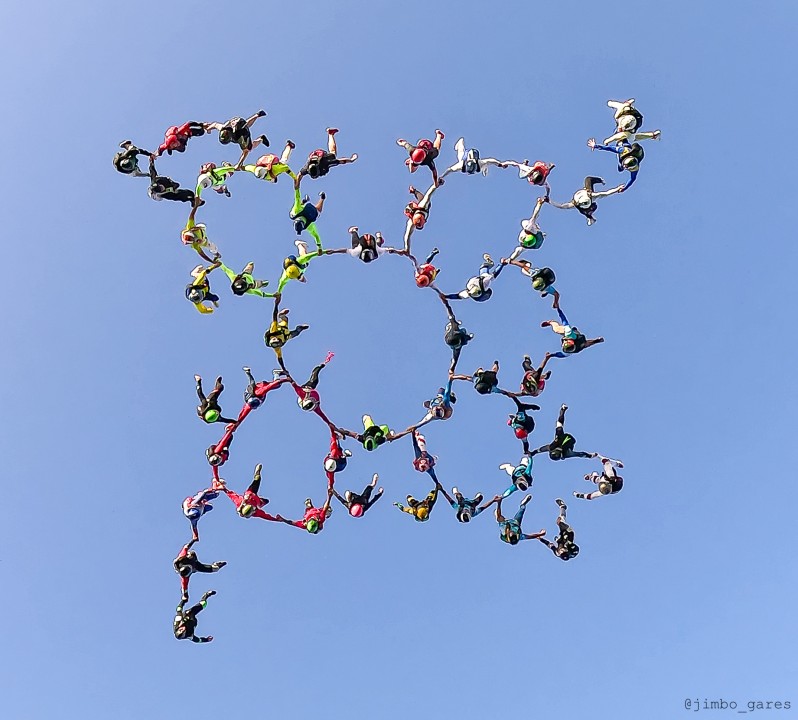
In 2023, I took part in the French freefly record: 54 skydivers flying head-down holding hands in a single formation. A record like this took 9 years to establish, and several days of attempts, with six to eight jumps a day. The flying itself is not very technical but these types of skydives require intense concentration from everyone. Everybody on the planes has enough individual flying skills to do the job, so what allows the record to succeed is how much of the participants’ attention can be directed towards achieving this common goal, and the organizers know it. They manage the energy of 54 nervous systems: the concentration during the briefings and rehearsals on the ground, the pace between jumps, when to change flyers in the formation, and above all how to debrief a failed attempt, while keeping the positive group spirit and the collective motivation at its peak. After participating in many such record attempts, I’ve observed that it never works when flyers are focused on showing their individual skills. Attention must shift from the individual ego to the collective success. Then, on the jump that works, something happens that is hard to describe. At some point, each flyer stops flying as an individual and starts flying as part of a team moving in sync. During those few precious seconds, it literally feels like there is an energy flowing between us through our arms. It is this energy that drives us to come back to each training event and record attempt.
During that record, I observed what the leaders did:
- They always debriefed with a growth mindset – highlighting the positives before the areas for improvement, never pointing fingers in public. When they had to replace a flyer with a flyer from the reserve group, they would talk to the flyer concerned individually, with kindness.
- They taught us visualization practices to best manage our energy during each plane ride before jumping.
- They fostered our team spirit through various rituals such as taking a few deep breaths while holding hands during the plane ride. Over the years of failed attempts, we developed a deep sense of care for each other, which became a key success factor.
- They kept our attention focused on success, keeping a positive attitude even during moments of doubt.
- They sensed the energy of the team and assessed if we had enough energy to go for an extra attempt, or postpone it to the next day.
I have seen similar leadership skills in the best executive leadership teams we have worked with. Here are a few things I learned from them:
- They debrief without blame. Facts first, what worked, then what to improve, and never a finger pointed in public. The hard individual conversations happen one-to-one, with respect. A team that feels judged goes into a defensive state, and a nervous system scanning for threat has no energy left for the work.
- They manage their energy before they perform. The leader’s state sets the state of the room faster than any agenda. Before a board meeting, a negotiation or a difficult conversation, they take two minutes of slow breathing and picture how they want it to go. They arrive regulated instead of regulating in front of everybody.
- They build rituals of connection. They start meetings with the people before the agenda and protect a few minutes of real human contact, for example with a short “inner weather” check-in round. Over time, these small rituals build a sense of care that is a performance factor, not a nice-to-have: it is what allows people to feel safe to tell the truth and to keep going after a failure.
- They keep the team’s attention on success. They name the threats explicitly rather than letting everybody scan for them, then bring the energy of the room back to the goal and to what can be controlled, and paint a vivid picture of what collective success looks like.
- They read the energy of the team and pace the work accordingly. They notice when the room is running on empty and postpone the decision rather than force it. And they treat the number of meetings, the expected response time to messages and the 11pm emails for what they are: energy allocation decisions. They protect focus time as visibly as deadlines, and recovery as firmly as any other to-do.
This is not a theory for us. We recently completed a one-year programme for the 70 top leaders of a European medical device company, with five workshops and our 100 Days Attention Mastery Challenge, in which each participant experimented with one new attention micro-habit every week. When we asked them at the end which practices they wanted to keep, the answer surprised us. Recovery and energy management came first, ahead of focus time and digital distractions. In their words:
“I have a clear awareness of my personal energy limits now.”
“Plan rewards, breaks and recovery time actively, and treat them as binding as my other to-dos.”
“I manage to get through the day with more energy and, in the evening, despite a heavy workload, I don’t have the feeling of having left something important undone.”
Nobody said “I became more disciplined”. They learned to manage their energy so that attention could show up again.
Their scores on our Attention and Body–Mind–Relationships self-assessment, before and after the 100 days, told the same story: as they learned to manage their energy through Attention Mastery practices, their Body, Mind and Relationships scores improved too.
Attention and BMR self-assessment scores before and after the 100 Days Attention Mastery Challenge. Source: NeuroMindfulness® Institute
And the most interesting part happened afterwards. Several of them ran the challenge with their own teams, and a common language around focus and energy spread through the organisation. Energy had become contagious, in the right direction this time.
What did the yogis know about energy?
Long before ATP and mitochondria, the yogis had their own model of energy. They called it prana, and they described it entering the body mainly through the breath and the food, the same two inputs we started this article with. They described it circulating through channels called nadis, with a cooling and restorative channel on the left, ida, and a heating and active channel on the right, pingala. Performance, in their view, lived in the balance between the two. Any neurophysiologist will recognise the pattern, even if the nadis are not nerves: an activating system, a restoring system, and health in their balance.
What strikes me most is their diagnosis of energy loss. For the yogis, energy is lost through a scattered mind much more than through hard work. Prana follows attention, and a mind that jumps between a hundred objects spends itself a hundred ways. Modern imaging says the same thing from the outside: most of the brain’s energy goes to the internal chatter of the Default Mode Network rather than to the task in front of us. The yogic remedies were pranayama, the regulation of energy through the breath, and dharana, one-pointed attention, which becomes meditation when it is sustained.
The yogis also describe energy as contagious. Being surrounded by people with high energy (they would say a high level of vibration) elevates our own, and the reverse is equally true. This resonates with the leadership view that energy is contagious, highlighting the importance for leaders to manage their own energy.
My own day starts with 20 to 30 minutes of pranayama followed by meditation, and I can tell the difference on the rare days when I skip it. Not only do I feel more energy on the days I practise, but much less of it leaks, since I feel much more focused for the whole day.
The top performing executives we work with have a practice of this kind, whatever they call it: breathing, meditation, a walk without a phone, a moment of silence before the day starts. They have understood, often without the neuroscience, that the most expensive network in the brain should not run all day for nothing.
So, what is energy?
It is produced in the body, by mitochondria that respond to how we move, sleep, eat and breathe. It is spent by attention, mostly by a prefrontal cortex that is expensive to run and quick to signal fatigue. It is multiplied or wasted by leadership, because it is contagious and limited. And it is preserved by presence, because a scattered mind is the biggest leak of all.
The executives who master energy management do not have more of it than the others. They produce it deliberately, they spend it consciously, they protect it in their teams and they stop it from leaking. None of this requires more willpower. It requires treating attention as an energy budget.
So here is the question I would leave you with: tomorrow morning, which side of your energy budget will you work on first, the supply or the demand?
If you want to get a free diagnostic of your level of attention mastery and its impact on your body, mind and relationships, we invite you to complete our Attention and BMR self-assessment.
And if you would like to bring this to your leadership team, we deliver a 90-minute online masterclass, “Attention Mastery, your superpower in the world of AI”. Contact us and we will find a date.
Frequently asked questions
How much energy does the brain use?
About 20% of the body’s energy at rest, for only 2% of its weight, roughly as much as all the skeletal muscles combined. During vigorous exercise the muscles burn about ten times more, while the brain’s consumption barely changes.
Does concentrating burn more energy?
Very little more. The extra cost of a demanding task is around 0.5 to 1% of the brain’s total budget (Raichle, 2010). Focus feels tiring because the cost is local, in the prefrontal cortex, and because fatigue is a regulatory signal rather than an empty tank.
Why do I lose focus in the afternoon?
Sustained attention depends on energy supply and recovery. After hours of meetings and task switching, the prefrontal cortex reduces its activation and the mind wanders. A sugar-heavy lunch, short sleep and constant interruptions make it worse. Working in 90-minute waves with real breaks, batching email and protecting the first hours of the morning for demanding work help.
What is the fastest way to restore energy during the workday?
A real break: a short walk, a few minutes of slow nasal breathing, or simply looking out of the window. Coffee and scrolling do not produce energy; they postpone fatigue and it comes back stronger later in the day.
How can leaders manage the energy of their team?
By debriefing without blame, regulating their own state before meetings, building rituals of connection, keeping the team’s attention on what can be controlled, and treating meeting load, response-time expectations and recovery as energy allocation decisions.
What is the 100 Days Attention Mastery Challenge?
A programme in which participants adopt one new attention micro-habit per week for 14 weeks, sharing wins and struggles with their peers, with the NeuroMindfulness® Attention and Body–Mind–Relationships self-assessment taken before and after to measure the shift.
References
Boksem, M. A. S., & Tops, M. (2008). Mental fatigue: Costs and benefits. Brain Research Reviews, 59(1), 125–139.
Leroy, S. (2009). Why is it so hard to do my work? The challenge of attention residue when switching between work tasks. Organizational Behavior and Human Decision Processes, 109(2), 168–181.
Mark, G. (2023). Attention Span: A Groundbreaking Way to Restore Balance, Happiness and Productivity. Hanover Square Press.
Picard, M., & McEwen, B. S. (2018). Psychological stress and mitochondria: A conceptual framework. Psychosomatic Medicine, 80(2), 126–140.
Rahimi, M. D. (2026). Energy deficit hyperactivity disorder (EDHD): A neurobiological energy dysregulation model for ADHD. Neuroscience and Biobehavioral Reviews, 184, 106616. https://doi.org/10.1016/j.neubiorev.2026.106616
Raichle, M. E. (2010). The brain’s dark energy. Scientific American, 302(3), 44–49.
Steiner, J. L., Murphy, E. A., McClellan, J. L., Carmichael, M. D., & Davis, J. M. (2011). Exercise training increases mitochondrial biogenesis in the brain. Journal of Applied Physiology, 111(4), 1066–1071.
Thomas, M., Sing, H., Belenky, G., et al. (2000). Neural basis of alertness and cognitive performance impairments during sleepiness. I. Effects of 24 h of sleep deprivation on waking human regional brain activity. Journal of Sleep Research, 9(4), 335–352.
Xie, L., Kang, H., Xu, Q., et al. (2013). Sleep drives metabolite clearance from the adult brain. Science, 342(6156), 373–377.
NeuroMindfulness® Institute (2026). 100×100 programme case study and post-100-days Attention & BMR self-assessment (client anonymised).













Leave a Comment