

The Leader Who Could Speak to Anyone – And Mean It Every Time
In my last corporate role, as Chief People Officer for Europe, I had the privilege of working directly for a CEO who taught me something I’ve never forgotten.
What made her exceptional wasn’t her strategy. It wasn’t her track record, though both were impressive. It was something far rarer: she could walk out of a Board meeting, step into a conversation with a journalist, and then spend an hour on the floor of a retail store with a team member – and in each setting, every single person felt like they were the most important person in the room.
Not because she was performing. Because she genuinely meant it.
She didn’t speak differently to a board member than she did to someone preparing pizzas in the kitchen. She adjusted her language, of course – but never her attention, never her presence, never her respect. And people felt that deeply.
Her teams didn’t just perform. They cared. And that caring translated into everything – retention, innovation, the way people showed up on the hardest days.
At the time, I observed all of this with admiration, but I couldn’t fully explain the mechanics behind it.
Now, after years working at the intersection of neuroscience and executive leadership, I can decode that magic. She was creating the conditions for people to operate from their highest levels of drive.
And that’s exactly what this article is about.
AI Is Accelerating. Human Energy Is Not.
AI writes your emails, drafts your strategy, analyzes your data. The pace is breathtaking. And yet, in the boardrooms and leadership conversations I’m part of, I keep hearing the same undercurrent: people are exhausted, engagement is low, trust is fragile.
The real competitive advantage in the age of AI isn’t which tools you adopt. It’s the level of human drive your organisation is running on when those tools go live.
Technology is neutral. Drive is not.
The Misunderstanding That Costs Leaders the Most
Most leaders think of motivation as something you either have or you don’t. When it dips, they reach for incentives: bonuses, town halls, a new strategy cascade.
But the neuroscience is clear: you cannot motivate people. You can only create the conditions for them to activate their own drive. Drive is a neurobiological state – it emerges from how safe, seen and purposeful someone feels. Change the conditions, and drive reorganizes. Ignore them, and no incentive package fixes what’s broken.
For a CEO, CHRO or COO, this is not a soft insight. It is a structural one.
Seven Levels. One Revealing Question.
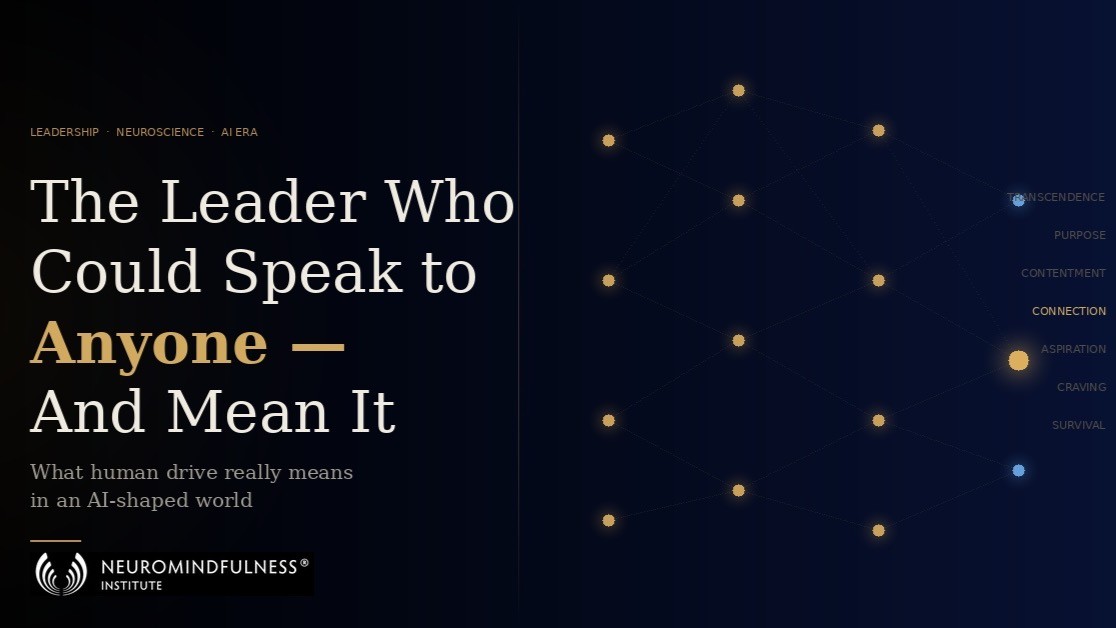
At NeuroMindfulness® Institute, we describe drive as existing across seven distinct levels – each tied to different emotional patterns and neurochemical systems, each producing very different behaviour in teams.
Let me walk you through them quickly, because once you see this map, you’ll start recognising it everywhere.
Level 1 — Survival. Fear. Threat. Status defense.
When teams are here, you see blame, silos, short-term thinking, and risk avoidance. Creativity is neurologically impossible when the nervous system feels unsafe. This level is more common in organisations than leaders want to admit. It can be helpful when you are in a crisis (e.g. electricity is off in your store, your customer facing systems are down), the problem is that we over activate it in business as usual.
Level 2 — Craving. Dopamine-driven urgency. Quick wins, status comparisons, constant notifications.
Modern work environments are designed to keep people here. It can fuel short bursts of energy – but as a culture, it produces exhaustion and shallow execution.
Level 3 — Aspiration. The energy shifts. Still dopamine, but now oriented toward growth, mastery, progress.
This can be ego-driven (“I want the title”) or purpose-driven (“I want to build something that matters”). Aspiration is the bridge – it can go either way.
Level 4 — Connection. Oxytocin comes online. Belonging. Trust. Collaboration.
People begin to care about the team’s success, not just their own. In high-performing organizations, this is cultivated deliberately.
Level 5 — Contentment. Often misunderstood. Contentment is not complacency.
It’s grounded stability – the ability to pause, regulate and hold perspective. Without it, aspiration burns people out. With it, performance becomes sustainable.
Level 6 — Purpose. Work aligns with meaning. Decisions become values-driven. Integrity becomes non-negotiable.
This is what stabilizes organizations when markets turn volatile and disruption hits.
Level 7 — Transcendence. The rarest. Service, legacy, ego-light leadership.
Leaders at this level mentor generationally. They elevate others as a default. Few organisations design for this, but the most trusted leaders I’ve worked with access this level of wisdom to recharge and inspire.
Where This Becomes Strategic
Back to that CEO I mentioned.
If I were to map her leadership against these levels, she was operating – and helping her team operate – primarily from Connection, Purpose, and at times Transcendence. Not because she’d read a framework. Because she intuitively understood that people need to feel safe, seen and part of something meaningful before they can give their best.
And the results weren’t soft. They were measurable. Lower attrition. Higher collaboration. Teams that kept performing through disruption because the foundation of trust was solid.
Now contrast that with what I see in organizations that have invested heavily in AI and digital transformation without acting on drive.
If your culture is stuck in Survival and Craving, AI will amplify reactivity. It will scale speed without scaling judgment. It will make you faster at the wrong things.
But if your organisation operates from Aspiration, Connection and Purpose, AI becomes a genuine force multiplier. Contentment is what great leaders activate at the end of a fiscal year. It is usually the little moment of joy when celebrating a year of achievements. Learning accelerates, trust compounds, execution sharpens, because people are energised by the work, not depleted by it.
The technology doesn’t determine the outcome. The level of drive does.
The Attention Factor (And Why It Changes Everything)
Here’s the neuroscience thread that ties this all together.
We spend roughly half of our waking hours mind-wandering. And what we repeatedly pay attention to trains our neurological baseline.
If your culture’s default attention loops around threat, comparison, urgency and digital noise, then Survival and Craving become the organizational default. Not because people are weak. Because that’s what the environment is training.
But if leaders intentionally direct attention toward safety, growth, trust, purpose, gratitude, the higher levels of drive strengthen.
Drive is not random. It is trained.
The question is: who’s doing the training? And is it intentional?
Three Questions Worth Your Quiet Attention
I will close the way I often close with executive coaching clients – not with a framework to implement, but with questions to sit with.
What She Knew That Most Leaders Are Still Learning
That CEO I worked with never used the word “neurochemistry.” She didn’t talk about oxytocin or dopamine or levels of drive. But she lived it.
She understood, perhaps instinctively, that her job wasn’t to push people to perform – it was to create the conditions where they wanted to. Where they felt safe enough to take risks. Connected enough to collaborate. Purposeful enough to stay.
What she did naturally, we can now do intentionally with the science to back it up and the tools to scale it.
I’ve seen leaders transform their cultures by starting with one small shift: deciding to pay deliberate attention to the conditions their people are operating in.
That’s where drive lives. And that’s where leadership in the age of AI will be won or lost.
About NeuroMindfulness® Institute
Founded in 2017 in Paris by Arnaud Complainville, PhD, former BCG Consultant, and Veronica Brejan, former Chief People Officer Europe and ICF-certified coach, NeuroMindfulness® Institute was built on a simple but urgent belief that
business leaders have the capacity, and responsibility, to create meaningful impact for both People and the Planet.
Our mission is to empower 1,000,000 people to take back control of their attention by 2030.
Today, we have a presence in 58 countries, with over 800 partners certified in the NeuroMindfulness® methodology. We partner with CEOs and HR teams to build focused, resilient, high-performing and human-centric organisations – through leadership programs for executives, high potentials and HR teams, certifications, and tailored interventions that blend neuroscience, mindfulness and 50+ combined years of corporate experience.
If you want to go deeper into these tools and learn how to apply them with your teams or clients, our NeuroMindfulness® Practitioner Certification is a self-paced online program designed to do exactly that. It’s how we equip coaches, HR leaders and executives to create the conditions for lasting behavior change, using the same methodology that underpins our work in 58 countries.
👉 Learn more at neuromindfulnessinstitute.com