


This article was inspired by conversations in the NeuroMindfulness® Institute Women Forum – a community of coaches, trainers, leaders, and master practitioners supporting each other to thrive as women, professionals, and changemakers.
What started as a vulnerable conversation about our fears and experiments with AI evolved into the framework you’re about to read.
The Day I Realised My Clients Needed Me Less (And Why That Made Me a Better Coach)
Six months ago, I noticed something unexpected in my executive coaching practice. My C-level clients, founders, and entrepreneurs – all deeply committed to their personal development – were booking sessions with me about three times less frequently than before.
I got curious. What I discovered wasn’t a problem. It was an evolution. They weren’t leaving coaching. They were augmenting it.
Between our sessions, they were using AI to do their reflection and learning work. They’d feed their own notes into ChatGPT or Claude. Some uploaded my coaching notes (with permission). A few had AI transcribe our sessions to detect patterns we might have missed together. They were asking AI for resources to explore themes we’d touched on. Generating reflection questions to sit with until our next conversation.
One founder told me: “I used to come to our sessions with vague discomfort. Now I come with clarity about the pattern and hunger for the breakthrough. Our time together goes so much deeper.”
AI didn’t replace me as a coach. It enhanced me.
My clients were doing more inner work than ever before. They were more prepared. More self-aware. More ready to go to the uncomfortable edges where real transformation happens. And when we met, we could dive straight into the depths because they’d already done the groundwork.
Here’s what this revealed: I wasn’t needed for the surface-level work anymore. I was only needed for the work that truly required a human.
That realization invited me to ask myself a question every coach, facilitator, and leadership trainer needs to answer right now:
What do I uniquely bring that AI cannot?
Here’s the context that makes this impossible to ignore: 75% of knowledge workers already use AI at work (Microsoft & LinkedIn, 2024). Your coaching clients are using it. Your training participants are using it. The leaders you facilitate are using it. Their organizations are building it into development programs.
AI isn’t coming to our field. It’s already here. Our clients have invited it in, whether we know it or not.
Yet many of us – coaches, trainers, facilitators, consultants – are still stuck in the “AI versus human” debate, as if transformation was a boxing match with only one winner standing. We’re asking the wrong question.
The real question isn’t “Will AI replace us?”. It’s “What kind of professionals do we need to become so AI makes us more powerful, not obsolete?”
Here’s what I’ve learned after two decades of coaching leaders, designing transformational learning experiences, and facilitating organisational change across continents: this isn’t about choosing sides. It’s about choosing evolution.
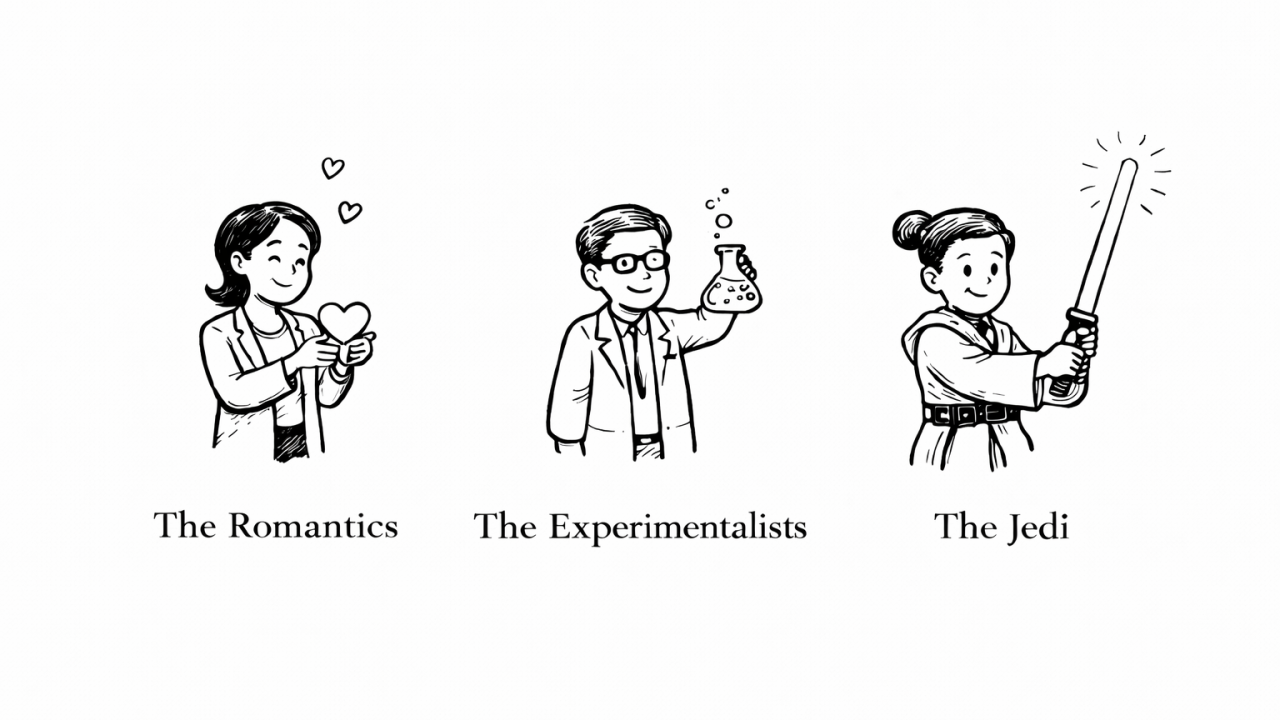
I started as a Romantic – convinced that the heart of our work could never be touched by algorithms. I’m now moving into Experimentalist territory, exploring tools that make me uncomfortable and excited in equal measure. And I’m aiming for what I call the Jedi level – not because I’ve mastered it, but because I’m committed to the transformation.
In the past months, I’ve noticed three distinct tribes emerging across coaching, training, and facilitation. Understanding which one you’re in – and which one you’re moving toward – might just determine whether you thrive or fade in the next decade.
1. The Romantics: The Human-Only Purists
The Romantics hold a beautiful, deeply-rooted belief: real transformation requires a real human. They see AI as a threat, a toy, or – at best – something irrelevant to the sacred work of developing people and organisations.
Their core beliefs sound like this:
- “Participants will always want a human facilitator in the room.”
- “AI hallucinates. It can’t feel. So it can’t truly develop people.”
- “If I ignore it long enough, maybe it will go away.”
- “Real learning is about presence, not prompts.”
Their strengths are undeniable: Deep ethics. Profound presence. The kind of human connection that changes lives and shifts cultures. These are the professionals who remind us why we do this work in the first place.
Research on inter-brain synchrony shows that when people truly meet in coaching conversations, learning experiences, or facilitated dialogues, their brains literally start to synchronise in regions involved in empathy and perspective-taking. This neural coupling – this genuine human resonance – is irreplaceable.
But here are the blind spots: Fixed mindset about technology. Binary thinking – either human or AI, never both. And here’s the part that should wake us up: a 2022 study comparing human coaches with an AI coaching chatbot found similar levels of goal attainment at the end of the process – even with a relatively old 2019 AI model (Terblanche et al., 2022). The researchers concluded that AI coaching can scale access and may replace the most simplistic, script-driven coaching styles.
Read that again: simplistic, script-driven.
If your practice relies primarily on following a model, asking predictable questions, delivering pre-packaged content, or facilitating with a playbook, you’re right to pause and reflect. Not because AI will replace deep, transformational work – but because we need to ask ourselves if we’re actually doing deep, transformational work.
Here’s the reframe that changed everything for me: it’s not about replacing humans. It’s about augmenting them. AI can be your thought partner before designing a learning experience. Your pattern-recognition assistant when analyzing group dynamics. Your content creation support when preparing materials.
My research on AI and decision-making shows that AI can either boost or bend our cognitive processes – the difference lies entirely in how consciously we design the interaction.
You don’t have to abandon your human-centered values. You just need to expand your definition of what “human-centered” means in 2026.
The invitation for Romantics: What if resistance to AI isn’t protecting the profession – it’s protecting your comfort zone? What would become possible if you got curious instead of defensive?
2. The Experimentalists: The AI Tinkerers
The Experimentalists are the curious ones. Open. Willing to stumble. They’re playing with ChatGPT, Claude, Gemini, Perplexity, custom GPTs, and whatever new tool dropped this week.
What they’re doing:
As coaches: Drafting post-session summaries that capture key insights. Generating powerful questions from multiple perspectives. Creating personalized reflection prompts.
As trainers: Designing experiential exercises tailored to specific learning objectives. Building case studies, AI agents, AI tools and scenarios. Creating pre-work and follow-up resources that adapt to different learning styles.
As facilitators: Preparing stakeholder questions before strategy sessions. Analyzing meeting transcripts for patterns and insights. Designing visual frameworks to make complex conversations accessible.
They’re learning by doing, not by waiting for the perfect certification program.
Their mindset: Growth mindset with healthy skepticism. “I don’t fully trust it, but I’ll test it.” They’re building what research calls learning agility – the capacity to learn, unlearn, and relearn across five dimensions: mental, people, change, results, and self-awareness.
Learning agility is not just a predictor of leadership potential – it’s the foundation of what they call “AI-readiness”: the ability to experiment with AI tools, think critically, and validate their outputs instead of outsourcing thinking to the machine. You will find more about learning agility in the world of AI in chapter 6 from our NeuroMindfulness Coach Certification Practionerl Level (self study).
Their strengths: They stay current. They discover what works and what doesn’t through lived experience. They’re not afraid to be beginners again. And they’re finding practical ways to serve clients better and grow their impact smarter.
But the risks are real: Tool addiction. Jumping from shiny object to shiny object without strategy. Lots of playing, limited integration into their actual methodology or business model. Experimentation without reflection becomes noise. They’re building a toolkit, but not yet a system.
And here’s what many Experimentalists miss: 78% of knowledge workers bring their own AI tools to work, and 52% are reluctant to admit it (Microsoft, 2024). Your clients and participants are already using AI – but they’re doing it in the shadows, worried it makes them look replaceable. As coaches, trainers, and facilitators, we have an opportunity to help them navigate this with wisdom, ethics, and strategy. But only if we’ve navigated it ourselves first.
The invitation for Experimentalists: You’ve proven you can play. Now it’s time to build. What would it look like to move from random experimentation to intentional integration?
3. The Jedi: The Builders & System Thinkers
The Jedi don’t just use tools. They design and stack them. They’ve moved beyond prompts into systems thinking.
What they’re building:
As coaches: Custom agents that support clients between sessions – reflection prompts delivered at optimal moments, pattern tracking across conversations, personalised resource recommendations based on individual development goals.
As trainers: Adaptive learning journeys that respond to participant progress, pre-work systems that assess readiness and tailor content, post-program reinforcement that maintains momentum without manual effort.
As facilitators: Preparation systems that analyze stakeholder perspectives before sessions, real-time synthesis tools that capture insights during conversations, follow-up workflows that turn decisions into trackable action.
They’re learning basic coding or mastering no-code/low-code platforms. They’re creating “virtual teams” – an ops agent, a research agent, a content agent, a client support system – that work seamlessly together.
They’re not asking “Can AI generate a good question?” They’re asking “How can I design a system where AI supports development between our human interactions in ways that deepen the work we do together?”
Their mindset: True AI growth mindset. “This technology will reshape my practice, so I choose to be a co-creator, not a bystander.” Long-term commitment to transformation, not just efficiency hacks.
Their strengths: Higher leverage – more impact per hour of human presence. They can design entirely new development experiences that weren’t possible before: between-session support that maintains momentum, adaptive content that meets people where they are, insight tracking that reveals patterns across cohorts.
They understand that the future of our field isn’t human or AI. It’s human and AI, orchestrated with intention.
The risks they navigate: Over-automation. Forgetting that coaching, training, and facilitation remain deeply human crafts. The non-negotiable need to keep ethics and data privacy at the center of every design choice. And the danger of building systems that create distance instead of deeper connection.
But here’s what the Jedi understand that changes everything: technology doesn’t diminish the human element. It can amplify it – if we’re intentional about how we build. When we use AI to handle content creation, pattern recognition, administrative tasks, and between-session support, we free up our human capacity for what AI cannot replicate: deep listening, nuanced intuition, holding complexity, reading the room, and that neural synchrony that happens when humans truly meet.
The invitation for Jedi: Remember that with great power comes great responsibility. Build systems that serve humanity, not just efficiency. Stay grounded in the why, even as you master the how.
Why the Experimentalists and the Jedis can only emerge in communities
Here’s what I’ve learned the hard way, and what the NeuroMindfulness community of learning keeps proving to me: AI learning is not a solo sport. The field changes too fast for any one person to keep up alone. We need collective intelligence – spaces where coaches share prompts, trainers exchange workflows, facilitators compare approaches, and we all admit our failures and celebrate wins without judgment.
Communities create:
- Psychological safety to experiment and be a beginner again, even after twenty years in the profession. To admit “I don’t know” and “I’m scared” and “I tried that and it was terrible.”
- Diverse perspectives on ethics, boundaries, pricing, and how to communicate all of this to clients and participants without triggering their fears.
- Accountability that transforms curiosity into concrete projects. The difference between “I should try that someday” and “I tested three approaches this week and here’s what I learned.”
This connects directly to the neuroscience of learning and collaboration. Research shows that when we learn together, our brains literally work better. We think more creatively. We spot blind spots faster. We sustain motivation longer. Attention mastery – knowing where to focus in an age of infinite possibility – becomes a collective practice, not an individual achievement.
Studies show that just three months of focused attention training can significantly reduce the “attention blink,” the moment where our brain misses new information because it’s still clinging to the previous stimulus. For coaches, trainers, and facilitators, this is exactly the kind of neural training that sharpens presence and deep listening.
The drive to keep learning, to stay relevant, to serve at the highest level? That’s sustained through community, not willpower.
Your Strategy Starts Here: A Self-Check for Coaches, Trainers & Facilitators
Take a moment. Get honest with yourself.
- Which type of professional are you today – Romantic, Experimentalist, or Jedi?
- Where do you want to be in 12 months to serve at the highest level?
- What is one small, concrete experiment you can start this week?
Stop asking: “Will AI replace me?”
Start asking:
- “How can I design my practice so AI makes me more human, not less?”
- “What human capacities do I need to develop that AI cannot replicate?”
- “What would become possible if I stopped resisting and started orchestrating?”
NeuroMindfulness® Institute Approach: The Three Superpowers AI Cannot Replicate
We don’t teach AI – you will discover it by yourself. We do teach the 3 superpowers that will support you to navigate the world of AI. Here’s what we know for certain after watching leaders navigate massive transformation, after training hundreds of coaches and facilitators, after stumbling through my own AI experiments.
The future belongs to professionals who master three uniquely human capacities:
1. Learning Agility
The willingness and ability to learn, unlearn, and relearn. To be a beginner over and over again. To experiment, fail, reflect, and iterate. Research shows this isn’t just about keeping up with technology – it’s the foundation of leadership potential in complexity (Williams & Nowack, 2022).
2. Attention Mastery
The capacity to be fully present. To listen at the level where real transformation happens. To read the room with all your senses. Systematic reviews show that mindfulness practice literally reshapes brain networks involved in attention and emotional regulation (Kirk et al., 2016). In a world of infinite distraction, your presence is your competitive advantage.
We designed a methodology based on the ARISE framework to help leaders get back in control of their attention. The engine of the journey to attention mastery is a 100 days attention mastery challenge, combined with our AI-powered Attention and BMR assessment.
This journey is supported by the latest research in Attention Mastery. Both this research and the details of our methodology to build an attention-conscious culture are covered in chapter 7 from our NeuroMindfulness Coach Certification Program.
If you want to test your attention mastery in 10 minutes and find your attention archetype, check our AI powered tool: https://form.typeform.com/to/H5GyfRHa
3. Understanding And Tapping Into Our Different Sources of Drive & Motivation
The massive job transformation and the re-skilling efforts are already generating a purpose crisis. In this context in which many of us feel a bit lost, understanding our deep sources of drive is a critical leadership skill.
We have built a 7 levels framework for drive, entirely designed based on the latest neuroscience research – each neurotransmitter mapped on your day to day life, with tools and practices to tap into each source of motivation when needed. Chapter 8 from NeuroMindfulness Coach Certification will be live early March.
These are the capacities that AI cannot replicate. And they’re exactly what allow us to work with AI as partners, not competitors.
This is what we’re building in our NeuroMindfulness Coach Certification – a space where neuroscience meets practice, where we develop the mindset and habits to lead change in this new world. We’re not just teaching techniques. We’re cultivating the inner operating system that makes coaches, trainers, and facilitators effective in complexity.
Because here’s the truth: the most powerful thing you can do in the age of AI is become more deeply, unapologetically, skillfully human.
The Heart Remains Human. The Toolbox Is Expanding.
Don’t be shy. Drop a comment. Share your experiments, your fears, your breakthroughs, your success. Let’s learn from each other.
The future of our field isn’t something that happens to us. It’s something we build together.
#WeAreMoreTogether
Author: Veronica Brejan, Co-founder & Managing Partner NeuroMindfulness® Institute in partnership with Perplexity, Claude, NeuroMindfulness GPT; inspired by the discussions within the community NeuroMindfulness Women Forum and by my sparring partners and favorite PhD geeks Arnaud Complainville, PhD and Alis Anagnostakis, PhD.
The NeuroMindfulness Coach Certification includes three modules designed specifically for the AI era: Learning Agility, Attention Mastery, and the Seven Levels of Drive. These aren’t just professional skills. They’re the superpowers that make you irreplaceable.
Check more about the NeuroMindfulness Coach Certification and the global learning community: https://neuromindfulness.thinkific.com/courses/neuromindfulness-coach-certification-practitioner-level












Leave a Comment