

By Arnaud Complainville, PhD — NeuroMindfulness® Institute
Is polyvagal theory dead? Since 39 scientists publicly challenged it, I keep hearing that claim. Here is why I still teach it — and how it helps leaders stay grounded under pressure.
Key takeaways
- Polyvagal theory’s neuroanatomy is contested — 39 scientists challenged it in 2026, and Stephen Porges responded — but its practical map of nervous-system states remains useful.
- The model describes three defensive states — Fight, Flight, Freeze — versus a Calm and Connect state where trust and human connection happen.
- Each state needs a different leadership response; reacting the same way to all three usually backfires.
- At the team level, chronic Fight, Flight or Freeze explains why many engagement and psychological-safety initiatives fail.
If you have done one of our courses or attended one of our trainings, you probably know that I do not like pop science or oversimplifications. For example, it enrages me when I hear “we only use 10% of our brains”.
What Polyvagal Theory Actually Says
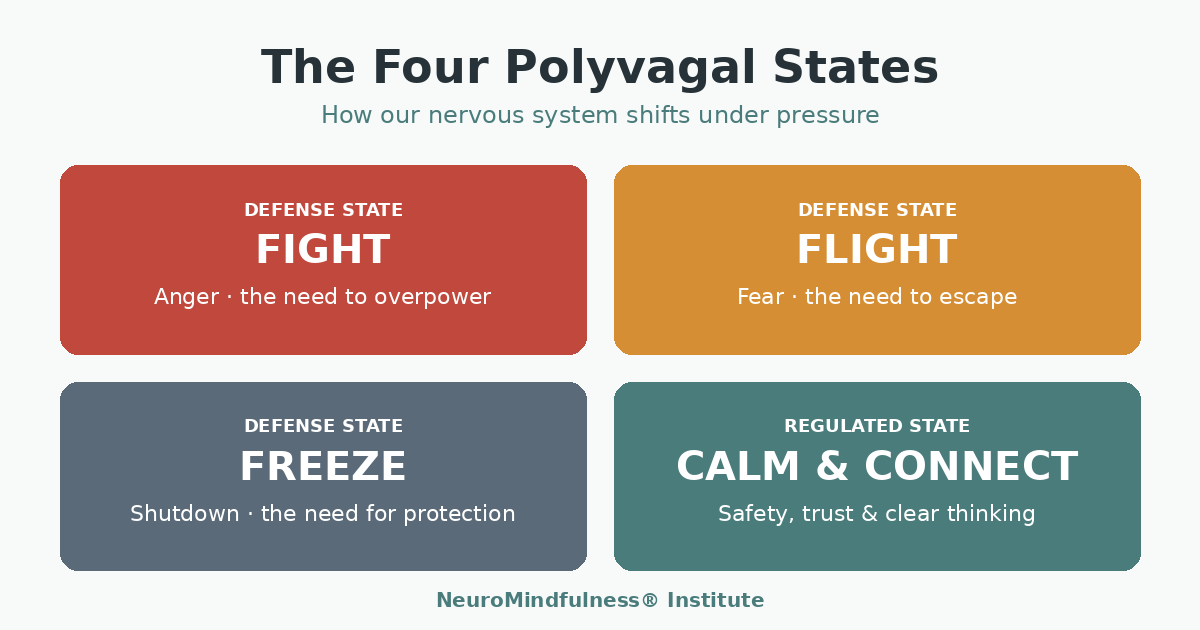
One of the concepts we have been teaching for years is polyvagal theory, often presented as Fight / Flight / Freeze / Calm and Connect. It describes the states that our autonomic nervous system can take, with three main defensive states (Fight / Flight / Freeze), in opposition to the Calm and Connect state, in which human connection and trust can happen. This theory has been widely used in psychotherapy, in particular in trauma therapy, and is also very useful in the leadership development space.
This theory was coined by Stephen Porges in 1994, and was challenged in an article signed by 39 scientists, to which Stephen Porges responded. What they are attacking is the neuroanatomical basis of the theory (ventral vagus vs. dorsal vagus, for example). This challenge is not new, and when I present polyvagal theory, I always mention that some elements are scientifically debated, and I do not dwell on the anatomical details.
Why I Still Teach a Contested Theory
Why do we keep presenting it if parts of it are scientifically contested?
First, as a scientist, I know that any framework is only valid until proven wrong by the next one. Any attempt to understand life is anyway a simplification, since life is too complex to fully grasp, and in particular our nervous system.
Second, I’ve seen in the room many times how this theory can bring applicable awareness of how we react, and offers tools to adapt our communication when we detect that someone is in one of the defense states.
The Three Defense States: Fight, Flight and Freeze
Some people tend to go more into fight, others into flight when triggered. Fight is more characterized by anger and flight by fear. When we do not see any escape from the situation, we can go into freeze, which is a more extreme defense reaction that is harder to get out of. Freeze is often associated with a trauma response.
Learning to recognize these states and understanding your preferred defense reaction brings awareness of how you show up in tense moments.
When we go into one of these three defense reactions, we have different needs:
- Someone in fight feels the need to overpower or intimidate.
- Someone in flight feels the need to escape the threat or constraint.
- Someone in freeze feels the need to find protection and shelter.
How to Respond When Someone Is in a Defense State
As a leader, when you detect that someone is in one of these three states, you should not react the same way for all three:
- If your colleague is in fight, you should not try to overpower them, slow things down, or use humour. I tried humour with my wife in those situations, and trust me, it does not work 😊. You should remain grounded, listen, accept, and offer solutions.
- If your colleague is in flight, you should avoid constrained reasoning at all costs: closed questions, aggressivity, judging. What you should do is show autonomy and provide a way out. Inviting the person to take a walk is great because it gives a physical way out. Humour can work with someone in flight.
- If your colleague is in freeze, wake-up calls and trying to instil courage and willpower are bound to fail. You should try to offer protection, respect the person’s silence, try to understand, and define very small steps.
Polyvagal Theory at the Team and Organizational Level
At the team or organizational level, this framework is also useful to understand why most initiatives to improve engagement fail. When a team or a company is chronically in one of the three defensive states, it is very hard to build engagement and trust because the Calm and Connect state is not accessible.
- When a team is in fight, it is not too bad, since there is energy in the system, and that energy can be channelled toward something productive. This is the most common state we see in organizations.
- Flight can be a bit trickier, since the team first needs to be reassured. Here we might see what we call the “Fawn” response (Please and Appease), a mix of fear and forced connection. People pretend to agree out of fear. This behaviour can be particularly destructive, especially if people tend to sugar-coat bad news out of fear of repercussions. It is the opposite of psychological safety.
- Freeze can be really hard to get out of at the team level, because that state is the furthest from Calm and Connect. Here we witness massive disengagement if the team feels trapped in an unwanted situation.
Here, I did not have to mention any anatomical basis of these three states, and therefore I could get out of scientific trouble.
What I want to illustrate here is that even though we should strive to be as scientifically correct as we can, some theories — even if they are outdated — hold some practical value in self-awareness and leadership.
So, is polyvagal theory dead? As a piece of neuroanatomy, perhaps. As a mirror for how we show up under pressure, and how we help others feel safe enough to think clearly again, far from it. The next time a conversation turns tense, ask yourself a simple question: which state am I in, and which state am I creating in the person in front of me?
Frequently Asked Questions
Is polyvagal theory scientifically valid?
The neuroanatomical basis of polyvagal theory is genuinely contested — a 2026 critique signed by 39 scientists challenged it, and Stephen Porges published a detailed response. The debate centres on the anatomy (such as ventral vs. dorsal vagus), not on whether people visibly shift between defensive and connected states.
What are the four polyvagal states?
Three defensive states — Fight, Flight and Freeze — and one Calm and Connect state in which trust, human connection and clear thinking become possible.
How can leaders use polyvagal theory?
By recognising which defensive state a person (or a whole team) is in and adapting their response: stay grounded and offer solutions with someone in fight, provide autonomy and a way out with someone in flight, and offer protection and small steps with someone in freeze.
What is the “fawn” response?
Fawn (Please and Appease) is a mix of fear and forced connection in which people pretend to agree out of fear of repercussions. At the team level it undermines psychological safety because bad news gets sugar-coated.
Sources
- Porges, S. W. (1995). Orienting in a defensive world: Mammalian modifications of our evolutionary heritage. A polyvagal theory. Psychophysiology, 32, 301–318. https://doi.org/10.1111/j.1469-8986.1995.tb01213.x
- Grossman, P., et al. (2026). Why the polyvagal theory is untenable. Clinical Neuropsychiatry, 23(1), 100–112. https://doi.org/10.36131/cnfioritieditore20260110
- Porges, S. W. (2026). When a critique becomes untenable: a scholarly response to Grossman et al.’s evaluation of Polyvagal Theory. Clinical Neuropsychiatry, 23(1), 113–128. https://doi.org/10.36131/cnfioritieditore20260111
- Porges, S. W. (2025). Polyvagal theory: current status, clinical applications, and future directions. Clinical Neuropsychiatry, 22(3), 169–184. https://doi.org/10.36131/cnfioritieditore20250301
About the Author
Arnaud Complainville, PhD, is co-founder of the NeuroMindfulness® Institute, a former BCG consultant, former business executive in the healthcare industry, and holds a PhD in Molecular Biology. He applies neuroscience research and mindfulness practices to executive leadership programmes, coaching, and retreats.