

This article was originally written for ICF UK and first published on the ICF UK website. It is republished here with permission.
By Arnaud Complainville, PhD & Veronica Brejan — NeuroMindfulness® Institute
Key takeaways
- Attention is the foundation of leadership, not just one skill among many — strategic thinking, listening, and decision-making all depend on it.
- In an assessment of 900+ leaders across 30 countries, attention scored the lowest of four dimensions (just 57.3%), with roughly three-quarters operating with a compromised attention system.
- A 100-Day Attention Mastery Challenge pilot raised average attention scores from 61% to 75% and cut struggling profiles from 74% to 10%.
- Coaches can build attention as a trainable capacity using the ARISE framework: Awareness, Reset, Intention, Strengthen, Embody.
The Invisible Crisis in Plain Sight
Think about the leader you coached last week. Perhaps she was preparing for a board presentation while sorting messages from three direct reports, scanning headlines between meetings, and quietly worrying about a conversation she had been postponing. She was doing everything expected of her, but she was nowhere fully present.
Distraction is the invisible crisis of our time. As executive coaches, we help leaders delegate better, communicate more clearly, think more strategically, and this leadership development work matters profoundly. Yet beneath all of these capabilities lies a more fundamental one that we rarely address directly: the ability to master and direct one’s own attention — what we at the NeuroMindfulness® Institute call attention mastery. The ICF recognises Maintains Presence as a core coaching competency, the capacity to be fully conscious and present with the client. But what happens when the leaders we coach have lost that very capacity themselves?
Attention is not simply one leadership skill among many; it is the cognitive and neurological foundation from which every other capability grows. Without it, strategic thinking becomes scattered thinking, empathetic listening becomes half-listening, and decisive action becomes reactive impulse. Attention has become the mind’s most valuable currency; finite by nature, deeply personal, and for most leaders, quietly slipping through their fingers.
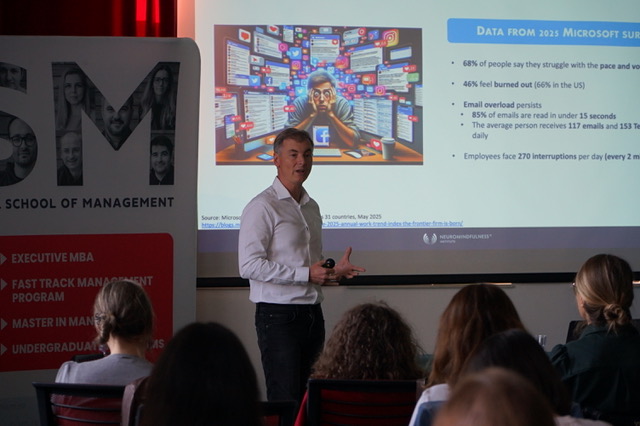
The data confirms what many of us sense in our coaching sessions, and what neuroscience research now validates. A Microsoft study found that 68% of leaders struggle to keep up with the pace of work, 46% feel burned out, and the average leader receives 275 professional emails and instant messages per day, being interrupted every two minutes.
Attention is more like a diesel engine than an electric car. It takes 15 to 23 minutes to return to its peak after an interruption. Most leaders never reach full cognitive performance in a regular working day. They operate in a state of constant partial attention, not because they lack discipline, but because the environment they inhabit was never designed to support deep, sustained focus.
What the Data Reveals About Leaders Today
To understand the scale of this brain-based challenge, we assessed over 900 leaders across 30 countries using the Attention & BMR Assessment, an evidence-based diagnostic tool designed by the NeuroMindfulness® Institute, powered by an AI agent that assigns each leader an attention archetype with personalised insights. Out of four dimensions measured (Attention mastery, and its impact on Body, Mind, and Relationships) Attention scored the lowest, at just 57.3%. 40% of leaders fell into the Scattered Multitasker profile, pulled in every direction, rarely fully present. A further 19% were Anxious Overthinkers, consumed by internal noise, and 18% were Wired & Tired, running on adrenaline, scoring lowest on body. Together, three quarters of leaders we assessed were operating with a compromised attention system. Not because they lacked ability or motivation. Because in the day-to-day rush, they rarely have time to stop and create space for honest self-awareness.
What 100 Days of Attention Mastery Practice Changes
That conviction led us to design the free 100-Day Attention Mastery Challenge, built on a hypothesis rooted in neuroplasticity: if attention is a trainable capacity, and not a fixed trait, what does deliberate practice do to it over time? The journey introduces one new brain-based micro-habit each week, drawn from neuroscience and mindfulness research, building progressively toward a Sustainable Attention Architecture. As a coach, you can support your clients through this intentional practice using the ARISE coaching framework we built and tested at the NeuroMindfulness® Institute: Awareness, Reset, Intention, Strengthen, Embody.
The results from our pilot cohort of 55 participants were significant. Average attention scores rose from 61% to 75%. Before the challenge, 74% of participants were Scattered Multitaskers, Wired and Tired, or Anxious Overthinkers. After, these fell to 10%. The dominant post-challenge archetypes became Balanced Explorer (present, flexible, intentional) at 53%, and Attention Alchemist (high engagement across all dimensions) at 33%.
These represent a genuine transformation in self-awareness, cognitive performance, and the capacity to lead with mindful presence, the kind of shift the ICF core competency Evokes Awareness describes as facilitating client insight and learning. One senior leader captured his journey in powerful words:
“The challenge helped me snap out of my complaining pattern about my busyness and empowered me to do something about it.”
That sentence carries the full weight of what we are really talking about: leaders reconnecting with the aliveness that sustained attention makes possible and that distraction quietly steals, one notification at a time.
What Leaders Discovered About Themselves
Semantic analysis of participant responses revealed a marked vocabulary shift. Before: overwhelm, multitasking, reactive, exhausted. After: intentional, energy, boundaries, sustainable, choice.
Leaders who had spent years trying to focus harder discovered they first needed to tend to their energy, through sleep, movement, recovery breaks, and digital wellbeing practices, before attention could be reliably sustained. The most impactful practices were accessible ones: reducing digital distractions, establishing focused time blocks, improving sleep hygiene, and implementing a morning mindfulness routine. What had been missing is the structure and compassionate accountability that neuroscience-based coaching uniquely provides.
The Organisational Dimension — and the Coaching Opportunity
One of the most encouraging findings came from a European organisation where 100 senior leaders went through the challenge together as part of a year-long NeuroMindfulness® leadership development programme. Leaders began noticing changes in each other’s communication, developed shared language around attention, and co-created attention-conscious team norms. Several have since rolled out the challenge to their own teams, and they are planning to roll it out to the whole organization.
One CEO working with NeuroMindfulness® over the last two years had an insight that crystallised something we had long intuited:
“I used to think our competitive advantage was our product and our people. Now I realise there is something even more fundamental: our collective ability to pay attention in a world that has forgotten how. That is an extraordinary competitive advantage.”
She was right. In a world of constant digital distraction, the ability to think clearly, listen deeply, and be genuinely present is becoming rare, and immensely valuable. Attention mastery is a leadership capability with systemic reach when it moves from individual practice to organisational culture, and this is what makes it uniquely relevant to us as executive coaches.
A Question Worth Bringing Into the Room
Our mission at the NeuroMindfulness® Institute is to help 1,000,000 people get back in control of their attention, their energy, and their life by 2030.
Coaches are uniquely positioned to lead this movement — and to build attention mastery into their coaching practice. Every leader you help reclaim their attention sends a ripple outward, to their team, their family, their organisation. As AI absorbs routine cognitive tasks, the irreplaceable human edge will not be speed or information processing. It will be the quality of attention a leader brings to the conversation in front of them, to the decision that requires genuine judgement, to the person who needs to feel genuinely seen.
Attention is shaped by daily habits, brain-based coaching, and intentional mindfulness practice. It connects a leader’s inner world to their outer impact. And it is coachable.
What would change for your clients if you coached not just for what they do, but for how fully they show up?
Frequently Asked Questions
Why is attention considered an executive superpower?
Attention is the cognitive and neurological foundation beneath every other leadership capability. Strategic thinking, empathetic listening, and sound decision-making all degrade when attention is fragmented. As AI handles more routine cognitive work, the quality of a leader’s attention becomes their most distinctive and durable advantage.
Can attention actually be trained, or is it a fixed trait?
Attention is a trainable capacity, not a fixed trait. Rooted in neuroplasticity, deliberate daily practice measurably improves it. In a 100-day pilot, average attention scores rose from 61% to 75% and the share of struggling profiles fell from 74% to 10%.
What is the ARISE coaching framework?
ARISE is a coaching framework developed and tested at the NeuroMindfulness® Institute to help clients build sustainable attention: Awareness, Reset, Intention, Strengthen, and Embody.
What are the most effective habits for improving attention?
The most impactful practices are accessible ones: reducing digital distractions, establishing focused time blocks, improving sleep hygiene, and adopting a morning mindfulness routine. Tending to energy — sleep, movement, and recovery — often comes before focus can be reliably sustained.
About the Authors
Arnaud Complainville, PhD, is co-founder of the NeuroMindfulness® Institute, a former BCG consultant, former business executive in the healthcare industry, and holds a PhD in Molecular Biology. He applies neuroscience research and mindfulness practices to executive leadership programmes, coaching, and retreats.
Veronica Brejan is co-founder of the NeuroMindfulness® Institute, with 25 years of global HR leadership experience at companies including Vodafone, KPMG, and YUM Brands. She is an international coach and facilitator with a mission to support leaders in understanding what makes us human in the world of AI.
This article was originally written for ICF UK and first published on the ICF UK website.